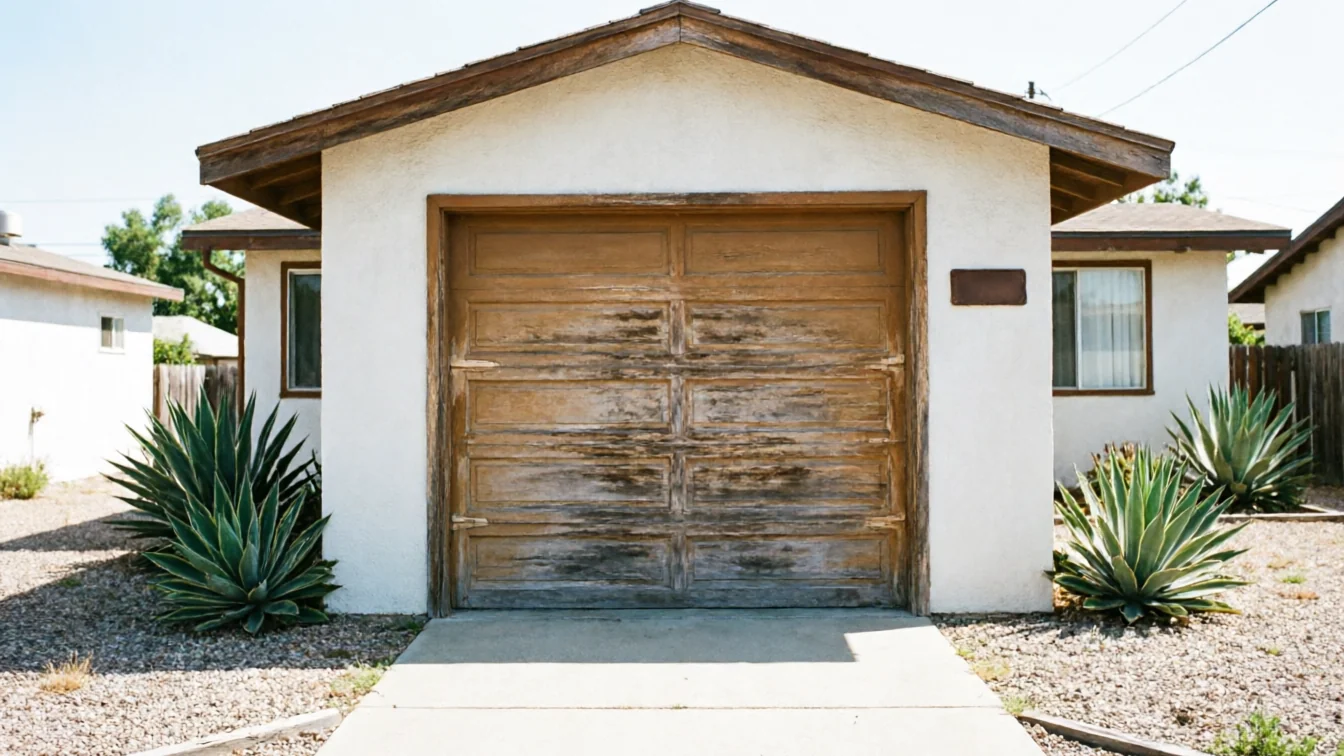
Local detail
When to Call Someone
Most of the houses around Agoura Hills went up between 1967 and 1999, with the bulk of that stock dating to the 1980s and 90s. That means a lot of doors out there are original or close to it - steel sectional doors on extension or early torsion hardware that was standard for that build era. If your door is from that first wave of construction and it's just making noise or sticking on one roller, that's worth a call before you write it off. A worn roller or a bent track bracket on a door frame from this period is usually a quick fix, not a sign the whole unit is done.
Where it gets different is the opener. Houses from the late 70s and early 80s often had openers added or swapped out later, sometimes more than once, so the opener's age doesn't always match the door's age. If the door panel itself is original to a 1980 build and still square and rust-free, fixing the hardware around it is almost always the cheaper path. If the panel is dented, delaminating, or the bottom section has rotted out from moisture at the slab, that's a different conversation - and usually means replacement makes more sense than another patch.
The area
The Seasonal Bit
Agoura Hills sits in a mild temperate band, so we don't get the freeze-thaw cycles that crack torsion springs and warp wood panels the way colder inland areas do. That's actually good news for older doors here. A steel door from the 1980s or 90s that's been kept in a garage without major temperature swings can hold its shape and spring tension far longer than the same door would somewhere with hard winters.
What does wear a door down here is UV and heat cycling on direct-sun exposures, which shows up as faded or chalky paint and, over enough years, panel warping on south- or west-facing garages. That's cosmetic more often than structural. If your door is from the original 1980s-era build and the finish looks rough but the panels are still flat and the door runs quiet, that's a paint job or a weatherstrip swap, not a new door.
What we find
What Local Conditions Do
With most of the area's housing dating to 1980 and the surrounding twelve neighborhoods built out through the 80s and 90s, a huge share of doors in Agoura Hills are hitting the 25-to-45-year mark. That's right in the window where springs, cables, and rollers are due for replacement on wear alone, regardless of how the door looks. Torsion springs on a door from that era are usually rated for a fixed number of cycles, and a door that's been used daily for three or four decades has likely burned through that rating at least once already, even if nobody's touched it.
The mild climate here means the metal itself isn't corroding the way it would somewhere humid or salt-air coastal. So when we're called out to a door from the 1980s build wave, the steel is often fine - it's the moving parts that have simply run their cycle count. That's the case for repair over replacement more often than not in this area.
How we work
What Is Going On
Here's the honest limit: if a door from the 1967-1999 construction wave has a broken spring, worn cables, and a dead opener all at once, we'll tell you straight that fixing all three separately usually costs close to what a new door and opener would run, and the new setup comes with better insulation and a longer service life. We don't pad out three small repairs to avoid recommending replacement when it's the better math.
What we won't do is tell you to replace a door just because it's old. Plenty of the sectional steel doors built during that 1980s wave in this area are structurally sound - flat panels, no rust, tracks still true. If that's your door and it's just a spring or a sensor acting up, fixing it is the right call and the cheaper one. Age alone isn't the deciding factor here; the climate has been kind to these doors. It's cycle count and panel condition that tell the real story.
Talk to a local pro
Garage door trouble in Agoura Hills?
Same-day service with honest, upfront quotes.